This is Part Three of a 3-part essay. Part One is a situation analysis of the education landscape. Part Two focuses on the nature of innovation needed in the public education sector. Part Three is an invitation to experience one of many possible new prototypes for “school”, this one focused on secondary-age students, and to consider joining conversations about designing more.
Please note that there will be a follow-up “appendix” of sorts, also posted here, with more information on the ideas, the tools, and elements of the proposed prototype shared in this segment, as well as responses to some queries and reactions.
Preface: I was fortunate as a beginning principal to be introduced into a national conversation about updating and reinventing school, especially high schools. It was a time of thoughtful exploration and energetic partnership with progressive practitioners and supporters. Of note, the efforts enjoyed substantial investment from the private sector and major philanthropies toward building a better institution for young people. The mission was to update an institution largely unchanged for a century, one built on faulty premises of cognition, motivation, and youth development, one whose design favored sorting, compliance, and order.
I’ve been unfortunate to watch the unraveling of those redesign efforts and the loss of that sense of mission of the 1990s. Watching the public education sector descend into a mediocrity unlikely to survive the forces competing for its key elements for the sake of profit or politics compelled me to lay out the issues as I see them, and to suggest some new ideas. I hope this piece will inspire others to think more deeply about the past and more urgently about the future of our schools.
Larry Myatt
Part Three- On to the Possible
Welcome to Part Three of this series regarding the urgent need for innovation in our public schools. The most exciting thing in Part Three is you get to go to school! You’ll get a tour, seeing and hearing all about it from one of its students!
* It’s important to know that this isn't a "drop-it-anywhere", traditional school model. It is a purpose-built design rooted in a fresh set of values and structures, engineered to grow alongside and directly benefit the community hosting it. It’s only one possible approach, but a key, distinguishing feature is its focus on addressing the shortcomings of the traditional linkage among age-alike cohorts, bite-sized time increments, and notions of curriculum based on derelict principles, discussed in depth in Part Two.* That matters, because a core belief of our work is that the assembly line model school that was imposed on the industrialized nations at the turn of the 20th century has created the most intractable problems faced by schools, children and families. When the overarching values are school are uniformity of process and product, no amount of master planning, technical fixes, measurement, or testing can ever address or improve the outcomes.
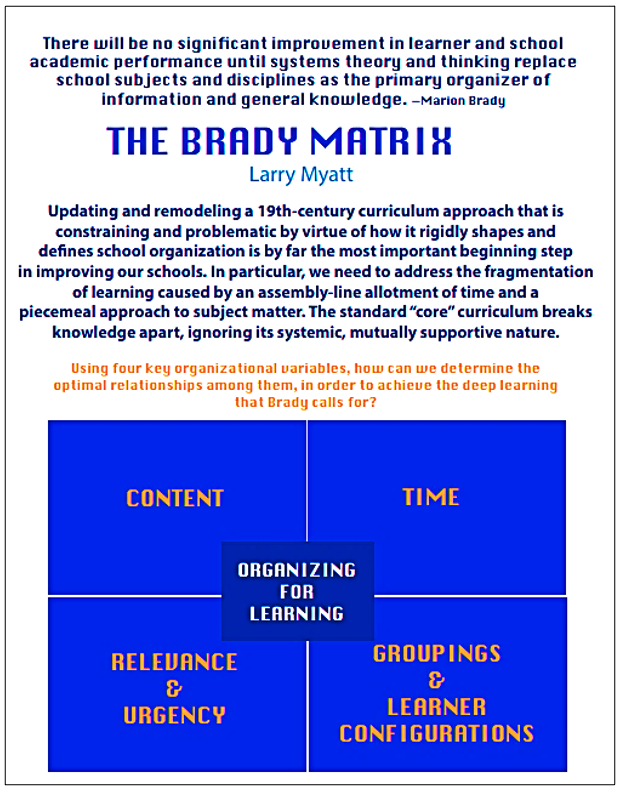
We’ve learned a lot, or should have learned a lot, about what doesn’t work when trying to improve our schools over the past three decades since No Child Left Behind. As our core belief statement above reads, we must come to grips with the fact that we can’t personalize or truly engage in “deeper learning” unless we develop different approaches to the Brady Matrix, seen above. The school you’ll be visiting offers one of many viable possibilities.
BUT….. before we go to school -and this is important- I’ll ask you to follow a simple “protocol” as you read. The “visit” is lengthy, so this way of reading will both help you make the most of it and to join or lead follow-up discussions of this different way of “doing school”. This is where we get the “juice”. (You can and I hope you will, invite friends and associates to join you in the reading AND in the protocol.)
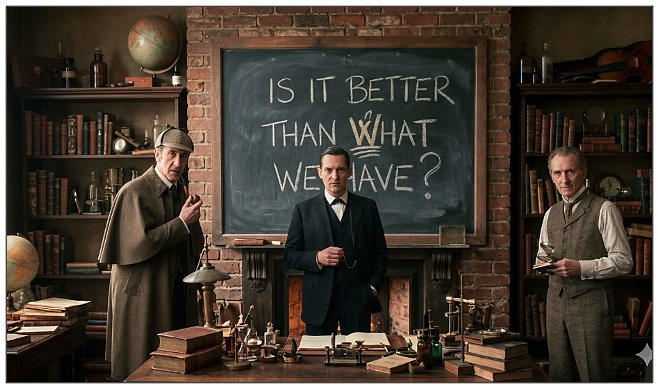
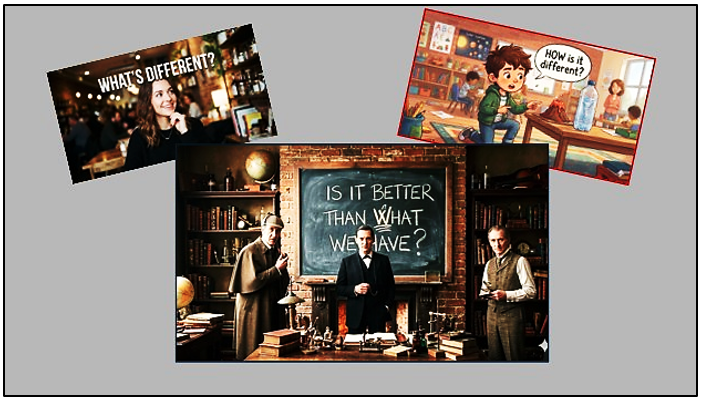
Sherlock Holmes, all three of him, is here to help us ask three big questions as we visit the school:
We need to be studious in asking these questions because if it’s better than what we have people will want and deserve one! We therefore suggest, as we meet and travel with Zach and his crew, that:
you read a few paragraphs at a time, noting the images
then STOP(!), pretend you’re Sherlock, and ask yourself the three questions above – What’s different? How is it different? IS IT BETTER THAN WHAT WE HAVE?
Some people will find it helpful to write a few thoughts down, and mark the section of the visit where “what’s different” emerges. Then, read on for a few more paragraphs or sections, stop again, and ask and answer those same three questions. The accumulated thoughts and notes can then make for an exciting community discussion on this prototype, this “mental model”, for what “school” could look like.
The school door is HERE!
Welcome back. Hopefully, you’ve been able to have a long, slow, look at the school experience, and, most importantly, ask yourself if it’s better than what we have.
If you enjoyed exploring this version of school, if you were excited or provoked, and you want to continue the conversation, please see the bottom of this page. Keep in mind, please, this is only ONE approach to a new school design. We’re looking for people who’d like to know more, ask questions, share their ideas, and connect with others who also want different and better. Small but sterling ideas can take root in unpredictable places. The people and communities behind those ideas can connect and the amplify the possibilities, growing deeper roots and spreading the seeds. We’ll need to think differently about “replication” and “scaling up”, focusing on making any pilot initiative as strong as possible using rapid feedback loops, and fostering the idea that real change is inherently a kind of learning.
Founding a school based on the right stuff will be challenging to start and nurture. We have to know going into it that any serious and meaningful innovation will at first be small, and, by necessity, local. It will be “unaccompanied” and fragile, not being a part of any existing “system” or ecology. Don’t be scared or put off by that!
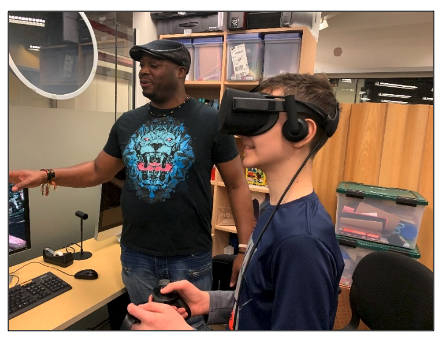
If you’re in agreement with the urgent need for innovation, please be in touch, talk to your friends and colleagues, reach out! The stakes are extraordinarily high. As I’ve written in the preface to each of the three parts:
Watching the public education sector descend into a mediocrity unlikely to survive the forces competing for its key elements for the sake of profit or politics compelled me to lay out the issues as I see them, and to suggest some new ideas. I hope this piece will inspire others to think more deeply about the past and more urgently about the future of our schools.
Please reach out at larry@educationresourcesconsortium.org