

Note: This is Part Two of a 3-part essay. Part One is a situation analysis of the education landscape. Part Two will focus on the nature of innovation needed in the public education sector. Part Three will pose an innovative prototype and suggest approaches to develop and connect with others.
Preface: I was fortunate as a beginning principal to be introduced into a national conversation about updating and reinventing school, especially high schools. It was a time of thoughtful exploration and energetic partnership with progressive practitioners and supporters. Of note, the efforts enjoyed substantial investment from the private sector and major philanthropies toward building a better institution for young people. The mission was to update an institution largely unchanged for a century, one built on faulty premises of cognition, motivation, and youth development, one whose design favored sorting, compliance, and order.
I’ve been unfortunate to watch the unraveling of those redesign efforts and the loss of that sense of mission of the 1990s. Watching the public educator sector descend into a mediocrity unlikely to survive the forces competing for its key elements for the sake of profit or politics compelled me to lay out the issues as I see them, and to suggest some new ideas. I hope this piece will inspire others to think more deeply about the past and more urgently about the future of our schools.
Larry Myatt
Part Two- Serious Innovation: What Is It and How Do We Get There?
In Part One, I surveyed the ways in which our public education system is stuck in pursuing efforts to address its key design flaws, and how so many key stakeholders resist innovation. In this segment, I’ll cite some persistent obstacles to improvement, touch on the nature of real innovation, and suggest some ways we might work and think differently. And in the finale of this installment, I’ll draw attention to an area where attention seems most required. Reader alert: this is a jam-packed installment, so clear the decks!Part Two- Serious Innovation: What Is It and How Do We Get There?
In Part One, I surveyed the ways in which our public education system is stuck in pursuing efforts to address its key design flaws, and how so many key stakeholders resist innovation. In this segment, I’ll cite some persistent obstacles to improvement, touch on the nature of real innovation, and suggest some ways we might work and think differently. And in the finale of this installment, I’ll draw attention to an area where attention seems most required. Reader alert: this is a jam-packed installment, so clear the decks!
At its core, there seem to be two broad, underlying explanations for the lack of effort towards the changes needed in our schools. The first is, it’s just too hard… structurally and politically. People then quietly agree not to really try, and sadly no vital leadership has appeared over three decades to remedy that perspective. The likes of the “renewalists” (I term I prefer to “reformers”) of the 90s such as Sizer, Goodlad, Meier, Sarason, Levin, Senge, Boyer and others are nowhere to be found. The second, more regrettable, explanation is that we can do ok, can be just good enough, by sticking with the status quo and pretending all is well. The various parties involved conform, doing what they’re told. There are conferences and activities, “looking at data”, “learning walks”, and publications to serve as cover, while some as pointed out in Part One, make a bunch of money.
“Let’s pretend”. Over the past decade school districts of any size have created some kind of “Redesign Coordinator”, a “Department of Innovation”, or an “Office of Transformation”, names intended to show a commitment to forward thinking. But the poorly kept secret is that they are places where no actual innovation can be found.
When one asks people in those offices what they actually do, you generally hear about the same things they used to do but now perform with a new name emerging from their new configuration of offices. A routine adjustment to a funding formula, buying the latest math curriculum, or announcing a grant award to rehash an existing initiative: any of these can now pass as “innovation” since it comes out of the office with that name. A new “magnet school” here or there can also be touted as serious innovation even though they use the traditional design and almost always consist of relocated people with a STEM or Magnet Arts theme, established in hopes of keeping middle class parents in the district. “Let’s pretend” seems ok for some.
Why has it been hard for people who really want to try?
Claims of educational innovation ring hollow when virtually every aspect of the modern school retains the structures and purposes mandated by its 19th and early 20th century architects, The Committee of Ten. (See the image below. More from them later.) The work of that committee, steeped in bygone premises of learning and socialization, unapologetically intended as social engineering, continues to rule our schools.
Press enter or click to view image in full size
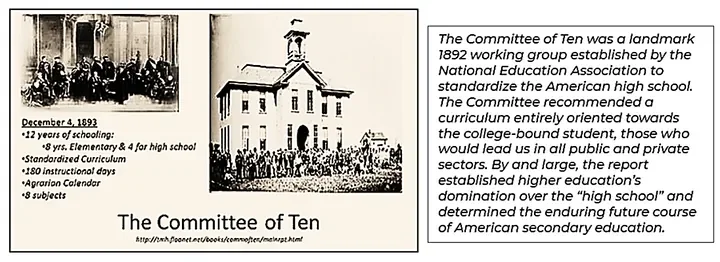
Certainly there have been sincere attempts to make changes over the years, so how is it that over a century later we’ve been unable to do anything structurally significant? (I don’t count adding emerging information technologies.) Why has it been so hard for those who have really wanted to try to make change?
“We have met the enemy….” Not surprisingly, human nature provides one of the enduring and impermeable obstacles to reconsidering what school might be. As Peter Senge observed in Schools That Learn: “We are all products of the industrial-age belief system and its ‘grammar’. Of all our nation’s common institutions, school sits the most ‘upstream’ for us. It was our first and most formative introduction to the set of unquestioned ‘arrangements’ that are school. As humans, we do our best to act in ways that re-create the age of our schooling. And, since school was upstream for all of us, this ‘water’ that we swim in comes back to haunt us when we try to re-imagine school.”
Entrepreneur Sal Khan adds to Senge’s perspective, “Human nature being what it is, those who prosper under a given system become supporters of that system, explaining decision-maker’s unshakable bias toward the status quo”. So, as the phrase goes, “we have met the enemy and he is us”. Furthermore, those most heavily impacted by the shortcomings of school — students, parents, and caregivers — are not decision-makers. The people most likely to want something new and different remain essentially powerless to make significant changes in the short or long runs.
The Impenetrable Thicket
Perhaps the most vexing set of obstacles resides in what noted educator Theodore Sizer called “the impenetrable thicket”. This choking regulatory and bureaucratic tangle includes, all at once, such elements as local and state statutes, narrow authorization parameters, contractual obligations, binding curriculum doctrines, seat-time requirements, highly specific state education codes, teacher time allotments, inflexible scheduling paradigms, volatile budget allotments, licensure requirements, poorly conceived accountability frameworks, and more.
Changes as seemingly simple as a new, hybrid bell schedule, who can teach a new integrated curriculum, or changing a course title routinely face abandonment or some diluted, unhelpful implementation. Veteran educators in any locale can provide you with scores of examples of how this daunting “thicket” repeatedly overwhelmed reasonable efforts to reimagine school. (We’ll dig deeper into the minutia of the thicket further down.)
A classic example of this phenomenon occurred in Minnesota. Beginning in 2009 their state legislature, under pressure from community groups and caregivers broadly dissatisfied with the educational options available to them, opened up school authorization to a wider circle of interested parties wanting better. There were many good people behind it, but the initial push to diversify authorizers and create greater school autonomy was largely co-opted by traditional forces caught fast in the “thicket”, causing original legislative goals to morph significantly in their implementation. While reformers there, as elsewhere, envisioned charter schools as highly independent laboratories of learning free from red tape, established educational forces and state entities soon succumbed to the thicket and instead codified reporting and oversight mechanisms that resulted in charters becoming essentially indistinguishable from traditional schools in their operations and regulations. In addition, many were authorized and run by home school districts that saw no need to change any operational designs. The same has happened across the nation with or without changes to authorization.
I was once hopeful that big names and big money — XQ/Emerson, New Schools, Annenberg, Gates, CZI, to name a few — could rally serious design practitioners and muscle the policy makers to help penetrate or even abandon aspects of the thicket. But, for the most part the funders have not understood the essence of the innovation required, have been conflict averse, obsessed with “scaling up” before they have anything to scale, or willing to accept boutique “adaptive” alterations. Some of them have evolved into mini-districts content with “design principles” with little innovation to offer, or they’ve changed course altogether.
“School” is too complicated for partial fixes. This phenomenon of interlocking, interdependent elements of school design helps to illumine a hard lesson that should have been, but wasn’t, learned from the past decades of “school reform”: that core elements of schools cannot be addressed piecemeal, one or two at a time. They are inextricably linked and codependent, held fast by the thicket, and when needed, by comfort and tradition. “Tinkering” doesn’t pay off. We’ve seen for twenty-plus years that even when motivated by good intentions and espousing helpful ingredients, attempting to improve the whole of the school experience by addressing one or two key elements repeatedly comes up short. The list is long: “merit pay”, “performance assessment”, “pacing guides”, “Common Core”, “SMART goals”, “small schools”, “Capstones”, “SEL”, “Learning Walkthrough’s”, “extended day”, “seminars”, “character curricula”, “block scheduling”, “soft skills”, “blended learning”, “teacher-run schools”, “one-to-one computing”, “SIPs”, “student learning objectives” — all are examples of how this phenomenon blunts potentially good ideas as well as the half-baked ones.
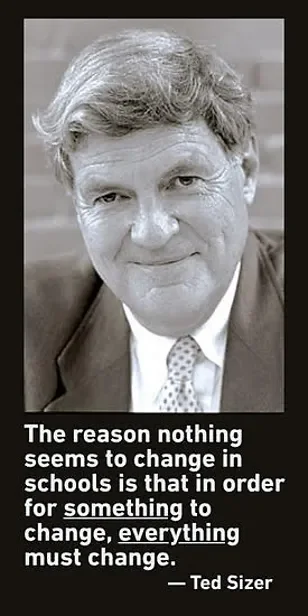
Once again, Theodore Sizer provided a guiding notion for us when rethinking school: “The reason nothing seems to change in schools is that in order for something to change, everything must change”. Once again, Sizer cut to the chase. But, for some, this explanation is taken as, “we just shouldn’t bother”. For others, it’s a call-to-arms!
Scar Tissue and a Look of Awe
Notably, when we track the advice of those outside “hired hands” described in Part One, we see that the partial solution approach lives on, still helping to shape state and district initiatives as well as philanthropic and occasional corporate investments. And making money for the consultants. The unintended consequence, however, is that these repetitive failures to produce the dramatic improvement promised have created frustration and disbelief in the possibility of change. “Educator scar tissue”, a principal called it. Teachers have heard so many silver bullet promises and seen so many unsuccessful attempts over the years that deep cynicism lies just below the surface ennui described in Part One.
The tempting idea of partial solutions, “adding vitamins to the body of school”, as a teacher deemed it, distracts us as we try to develop a new “consciousness” (more on that later) and a more solid problem-defining approach. A high school I once visited in Florida as part of a team of consulting educators, had thirty-eight simultaneous initiatives underway, most involving “outside” help with intermittent funding. More vitamins have to help, right? No. They’re impossible to integrate. Only a few years later, that same school was flagged for “persistent low achievement”.

Over the years I’ve worked with educators all over the nation, in serious pursuit of school redesign. I can recognize a certain look of panic that comes over their face when they fully grasp the magnitude of Sizer’s saying -that everything needs to change. It’s a look I can only compare to a first-time visitor approaching the edge of the Grand Canyon — a look of total, unfathomable, awe. With very few exceptions, the visitor backs away shaking her/his head (while quickly and silently deciding for themself what can be said or done now, if anything, in lieu of the abandoned quest).
I myself like to seek out the very few who want to keep looking down, who don’t get dizzy, who are inspired by the magnitude of the quest. If you might be one of those types, please keep reading! When the issues are so daunting and the status quo is acceptable, and for some, profitable, who wants to be part of trying to launch something fraught with uncertainty? Something so likely to incur the enmity of establishment forces? When the new and plentiful wisdom of two decades of educational neuroscience has essentially failed to penetrate the contemporary American school, what chance do we stand?
As expressed in the preface to each of the three parts of this essay, it’s my hope that these thoughts will inspire others to think more deeply and more urgently about the future of our schools. I continue to believe that there are smart, caring, down-to-earth folks out there, people among whom endures a persistent and troubling recognition that our educational system is not only sorely outdated, for many people it is limiting, if not outright harmful. And at the very least, we could be doing SO much better. Let’s focus, then, on some big ideas to help us move forward.
Four Ideas for Those Who Want to Try
1) Knowing what real innovation entails. We’ve seen how non-innovation can pass muster. So, what are we looking for? As described by Amabile and Pratt, even though creativity and innovation are interconnected they are distinct constructs. Creativity focuses on generating novel ideas, whereas innovation involves the practical application and implementation of ideas into tangible solutions.
The Innovation & Performance diagram below is one that emerged from the design community in the early 2000’s, a tool to help understand the nature of innovation in getting results (and ironically points out its absence in our sector).
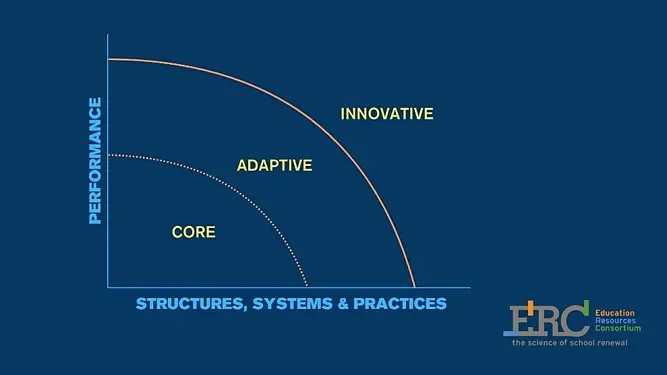
In the diagram, there are three zones of design intent:
· Core -the foundational, fixed, and essential nucleus of a system that remains stable regardless of external changes
· Adaptive -the modification of parts of the core that attempt to improve its performance or effectiveness
· Innovative- an idea which breaks through or challenges conventional wisdom to birth fresh ideas and different solutions; one that fundamentally changes the landscape and usually results in the abandonment of the core
Logic and history tell us that to achieve dramatically better results or solve seemingly intractable problems, one must transcend the core and adaptive zones in order to arrive successfully in the “innovative.” In the world of innovative inventions, we can think of the remarkable transition from the military use of bows and arrows to gunpowder and firearms in the 1500’s -a profound departure from the core and adaptive (long-bows, crossbows, panjagans). It also changed the nature of hunting, personal and community self-defense, creating new enterprises and industries while leaving other weaponry and military strategies behind. Consider other product transitions: from horses to autos, from cars to airplanes. Propeller airplanes to jets. Morse code to telephone land lines, to cellular phones, to smart phones. Copiers, laptop computers, space travel, medical imaging, RNA therapies. Now we’ve entered AI-land.
Historians and economists note that many of these advancements were made possible by institutional innovation — the creation of new rules, organizational structures, and social frameworks to manage risk and scale. Corporate R&D laboratories like Bell Labs and the General Electric Research Laboratory turned scientific discovery into a repeatable process by pairing theoretical physicists with practical engineers under one roof, yielding breakthroughs like the transistor and information theory.
In the United States, the U.S. Social Security Act of 1935 institutionalized a social safety net, leading to government-assumed systematic responsibility for pensions, unemployment insurance, or healthcare. The “G.I. Bill” of 1944 reshaped higher education from an elite privilege into an engine of mass upward mobility, and vastly scaled up workforce capabilities. In international finance emerged a new International Monetary Fund (IMF), as well as the notion of organized venture capital, two ideas that broke an adaptive plane.
In addition to “progress” these transformations demonstrate another key point: since things must and do change, when it happens the “core” will be impacted, often dramatically. Without doubt the vast majority of early 20th century people consciously defended the primacy of the horse for transport of all kinds. But it’s clear that they moved on to support the idea of cars. There was pain: blacksmiths, stablers, harnessers, granaries, and horse-dependent industries and professions lost their income and primacy. It was adapt or perish. The world moved on.
In some circumstances the core may survive as a lesser but viable alternative, suitable for some usage. It may linger as a relic but/or in a diminished form or state of importance: an antique car, a hunting longbow, a thoroughbred pulling horse, a land line. Or, like wooden wheels, bloodletting, or the telegraph, the core, be it an object, a belief, or practice, may be abandoned altogether. Those who inhabit the “let’s pretend” zone must accept the notion that true innovation requires breaking past that second threshold, moving beyond mild adaptation, and the core will likely be changed, or again, abandoned.
2) Einstein’s Message
There are many versions of the below quote attributed to Einstein, many not necessarily accurate. We are sure of what he did say in the New York Times in 1946, when the planet was slowly emerging from the urgency, stress, and dangers of a catastrophic world war. In that interview, a candid Einstein remarked that, “a new type of thinking is essential if mankind is to survive and move toward higher levels.”
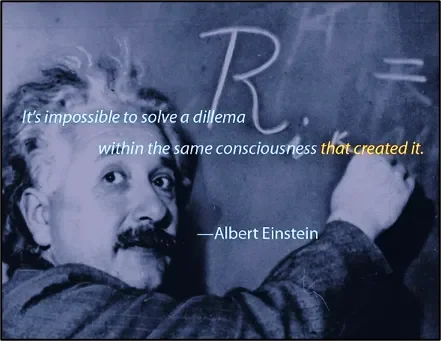
A working approach Einstein shared consistently throughout his career was to fully explore and define a/the problem first, before pursuing the solution. Per the image caption, he scrupulously reminded colleagues and onlookers that a problem created under certain assumptions, beliefs, or particular ways of thinking, is unlikely to be solved within that same framework. He further explained that, ironically, it’s often the assumptions, limitations, or the “blind spots” in our understanding that have led to the problem in the first place.
Looking at the list of innovations in the preceding segment we see how important it was to work from a new consciousness: if birds somehow fly, why couldn’t people? If we can’t build “out” could we build “up” (skyscrapers)? If steam explodes dangerously, could we use that force and energy somehow? Rather than draining our blood, could we alter other physiological or epidemiological factors to better health?
Rising waters and suffocating amounts of plastic are two dilemmas that occupy center stage, costing us money, time, and energy as we try to account for Earth’s future. But two fascinating examples of innovation show Einstein’s counsel at work:
For generations, seawalls have been built with one objective: hold back the water. Rather than concrete seawalls, Kind Designs uses ultra-fast 3D-printing robots to create artificial reefs and “living seawalls” twenty times faster, restoring biodiversity and strengthening climate resilience. This approach suggests that coastal infrastructure can do more.

Some 50 million tons of PET, a widely used packaging plastic, are produced annually, much of it ending up in landfills or oceans. Scientists at the University of Edinburgh have engineered E. coli bacteria to break down PET waste and convert it to chemical building blocks of terephthalic acid. Molecules of terephthalic acid are then transformed into L-DOPA, a frontline medication for the neurological disorder Parkinson’s Disease.

These two examples reveal a willingness to question prior assumptions and pursue possible blind spots in their previous understandings.
3) The essentiality of a mental model. How then do people, consumers of new ideas and products, adapt to and adopt truly new concepts? The adage “seeing is believing” is a good place to start.
Humans are programmed to stick to our conventional mental programming. Psychologists call this the “status quo bias”, a strong, automatic, often emotional bias that prefers the current state of affairs over a change. Without some kind of immediately appealing example, story, or demonstration, we’re generally okay to stick with what we have. This innate and predictable response of wanting what’s there at present, as Senge reminded, continues to shape our societal efforts when thinking about “school”. Especially among policy and system leaders.
What one can argue happens in the instances of dramatic innovation is the appearance of some kind of a tangible “mental model”, something that, although it looks and works differently, suggests its value and effectiveness, often immediately. As explained by Per Espen Stoknes, innovations are exceedingly difficult to imagine before they arrive. It isn’t until they’ve diffused into widespread use that they seem natural, ordinary, and commonsensical. (For our later discussions and Part Three, keep in mind that mental models and stories to accompany them are the essence of scenario thinking, imagining multiple plausible future outcomes by analyzing variables, trends, and uncertainties, rather than trying to predict a single exact future.)
My own story of mental models is one of having been content with my old and seemingly reliable flip phone. Until, that is, a colleague next to me at a principal’s meeting unveiled her brand-new “smart phone”. Silently pooh-pooing the new fad to myself, and disliking the moniker of “smart”, I was nevertheless quickly taken by what it could do. “Want to hold it?”, she asked? I bought one a week later.
Let’s bookmark this concept, please: the need for and power of mental models. Technically, working prototype is a better term than “model” for our purposes. People need to see the new, get close to it, and if they can touch it, taste it, handle it, then they want one!
Can you imagine what will happen when a bored -or exuberant- or struggling -or ultra creative child’s family hears about, then sees, something better? In a different school? One better for mind and spirit? Free? In their own backyard? We want one!!!
4) A Lesson from the “Skunk Works”
In June 1943, the U.S. Army’s Air Tactical Service Command (ATSC) met with Lockheed Aircraft Corporation to express its dire need for a jet fighter to counter the rapidly growing Nazi Germany jet threat. A month later, a young Army engineer named Clarence “Kelly” L. Johnson and his hand-picked team of engineers and mechanics delivered the XP-80 Shooting Star jet fighter proposal to the ATSC. This project marked the birth of what would become the Skunk Works®. The term “Skunk Works” came from Al Capp’s satirical, hillbilly comic strip Li’l Abner, which was immensely popular in the ’40s and ’50s. Kelly Johnson and his team designed and built the XP-80 in only 143 days, seven less than was required. It was Kelly’s unconventional organizational approach that allowed the Skunk Works, set up in a circus tent next to a plastics factory in Burbank (!) to streamline work and operate with unparalleled efficiency. He challenged the bureaucratic system that stifled innovation and hindered progress and won.
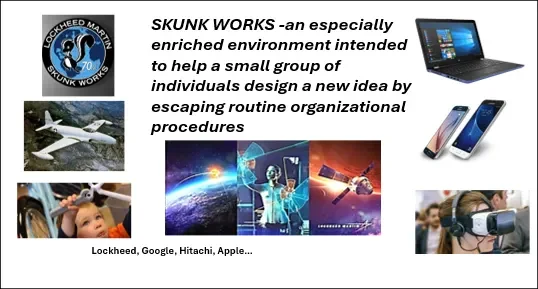
Today, “going skunk” is used to describe the creation of an especially enriched environment intended to help a small group of individuals design a new idea by escaping routine organizational procedures. Beyond Lockheed’s skunkworks, inventive companies like Google’s Google X organization use the same principles, as do Amazon, SpaceX, Adobe, Nike, MIT labs, and scores of innovating entities (not all of which we love but you get the idea).
Lockheed’s primary lesson — now a foundational concept — was the absolute necessity of isolation. As Steve Jobs famously noted, “It’s better to be a pirate than join the Navy.” To innovate successfully, designers must wall off their skunkworks from the host bureaucracy, the “mother ship.” Isolation provides vital protection from outside interference, stimulates risk-taking, fosters unconventional ideas, and acts as a powerful counterforce to organizational inertia.
That organizational inertia, the fear of failure writ large, is endemic to school policy leaders. That fear has blunted countless well-reasoned initiatives, prevents the sincere adoption of Einstein’s reminder, and it will continue to do. Any start-up must be given the total freedom to make its own rules, develop its own systems, language, timing, benchmarks and other associated elements.
These four guidelines can be at our disposal as we try to move toward new and different ways of thinking and working. They can help, especially in the early going, as we try to imagine a school experience that is “first different, than better”, a phrase from Elliot Washor and an important one. Innovating is a fundamentally different way of doing things that results in considerably better outcomes. Both the ‘different’ and the ‘better’ must be significant and substantial.
A Major Task Ahead: Questioning the Framework of School
In this last segment, I want to leave readers mulling a starting place for redesign, a critically important place to challenge the status quo, to move beyond the core and adaptive. Paradoxically, it may also be the most challenging area in which to obtain any traction, to get the needed grip to pull apart the Sizer thicket.
This tough nut to crack, one that has defied reasonable changes in “school” for a century, was spawned by the values and beliefs of our friends the Committee of Ten (1893), creating an untrustworthy, often perfidious, intersection of three determinants:
how we think of curriculum (“content”)
how we use time, and
how we group learners
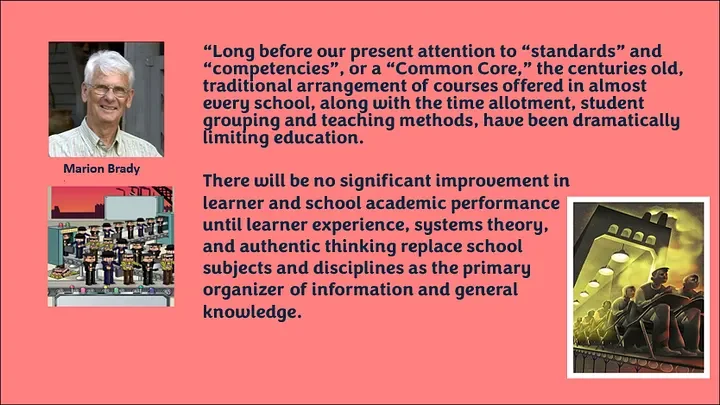
“At Odds with the Natural Desire to Learn”. In order to blaze any sort of trail through the Sizer thicket we will need to tackle this aggregation head on. Of the three elements, the curriculum thinking we were left to wrestle with is the most complicated and problematic and it drags the other two in its wake.
Beyond John Dewey and Ted Sizer, few people have spent more time thinking about that hugely complicated issue than Marion Brady. In the early-2010’s Education Week founder and redesign warrior Ron Wolk led me to Brady’s efforts, both of us admiring his vocal opposition to the corporate education reform movement. Reading Brady’s work, while recalling the many failed, piecemeal efforts, I saw the wisdom in his assertion, “Addressing the fragmentation of learning caused by an assembly-line allotment of time and a piecemeal approach to subject matter, is by far the most important beginning step in improving our schools”.
Here are some specific and important thoughts on curriculum from Brady. In particular, take a look at # 6, which encompasses perspectives of notable contemporary voices in neuroscience. Brady’s laundry list makes one wonder why we put up with something so thin, so much at odds with what we know about thinking, learning, and growing. And why, as educators, we have to look away rather than confronting these truths.
The Industrial School
The term “industrial age school” has grown tiresome for some educators and policy folks. It’s a criticism, after all. Some roll their eyes when they hear it –“oh, that again”. I think they actually roll them as a defense mechanism, shrinking from its true meaning, its unmentioned impact, and from our failure to address it. To me, it’s more important than ever to understand where that term comes from and why it’s important to parse.
Furthering Brady’s thinking in his “Schools That Learn”, Peter Senge distilled the Committee of Ten’s beliefs about learning and development and how they were intended to shape the school experience. He titles them “industrial age assumptions about school and learning”:
• the industrial management model breaks the school “system” into pieces; children experience school as a fragmented system of people, ideas, and transitions
• there are smart/fast kids and slower/not-smart kids
• students are receivers of “knowledge”, mostly facts and pre-determined answers to set puzzles they must solve
• uniformity of process and product dictates the assumption that all students should learn the same way
• there is a pace at which the machine moves forward; some learners lag, others fall off; we label and separate those that falter
• when kids’ performance fails to measure up, parents often feel failure, children experience anxiety
• multiple intelligences, learning styles, mood, and pace pose insurmountable hurdles in virtually every classroom; addressing variety is overwhelmed by the demand for order
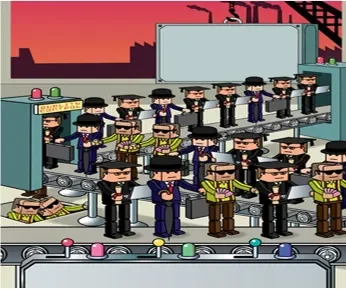
I’ve started countless teacher and administrator meetings with an exercise that reviews Senge’s assumptions above. Almost always, the participants, being educators, will dispute them, initially in silence. We often move on to discuss these arcane notions, their scanty logic, their silliness compared to what we now know of brain maturation and positive youth development. We seldom, if ever, discuss -out loud, together- the harm, small or large, these beliefs can do, and the irony we educators must live with. That’s where the eye-rolling comes from, I think. I persist in using this activity at least to call out the irony, the blind eye we must turn, knowing the model is not in truth good for so many children, but one which we must enact 180 days each year.
How does this tripartite design impact our institutions? Desired changes such as assigning a teacher to pilot a new integrated curriculum, finding time for grade-level teachers to meet, putting together a cross-grade project study group, a new bell schedule to allow for deeper inquiry, or changing a grading system to fit new, more sensible, learning criteria –any and all of these should be within our means. They should happen thoughtfully, but quickly, to benefit — directly and/or indirectly — the mission of teaching, learning, and youth development. How and why does it become so hard? Read on.
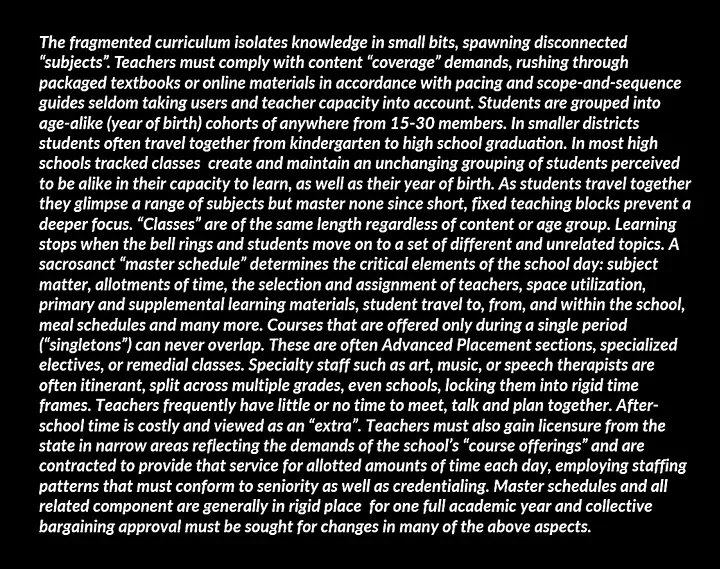
In black and white above we see the unquestioned blueprint of school’s inner workings. Good ideas, needed alternatives, better ways, fall victim to the values inextricably attached to those three determinants –curriculum (content), time, and learner groupings. Even essential, critical changes can take years, when and if agreed upon by varying factions, and only when not falling afoul of the statutes, contracts, codes, budgets, etc., and our old friend, tradition. We can hear Sizer’s voice again, “In order for something to change…”.
The archaic notions of curriculum that created the “thicket” still defy our attempts to imagine an institution, moreover an experience, far more appropriate and beneficial for the intellectual and social/emotional development for young people. The thicket has us! Now what???
A Road Ahead

“Take a deep, cleansing breath with me”, as yoga teachers often suggest.
Despite the heavy lift, the years of inertia, and the deceiving comfort of standing pat, I believe there are ways forward. A particular one will be discussed in Part Three, one of many possibilities. They’re paths that will require us to pay relentless heed to Einstein’s reminder: to imagine and operate within a “new consciousness”, paths that ask us to challenge the basic assumptions on which our industrial school model is built.
The other helpful ideas will also be there: the journey forward will require “separation” and intense collaboration a la skunk works, new prototypes and “mental models”, and a willingness to break the adaptive plane, pulling apart those faulty premises and presumptions about learning, about curriculum, even about the priorities of school. Committing to these ways of working can liberate our design efforts and lead us toward authentic and increasingly more specific design principles, followed by systems, boundaries, and action steps, the structural and programmatic changes needed to bring them to life.
Once the industrial age determinants have been intensely scrutinized, decoupled, and reengineered, the possibilities begin to emerge, energizing us, building confidence, as we question more aspects of a school model once thought untouchable. People will have to accept some losses, no doubt, as did those in the horse and buggy era, in favor of something different and better. We’ll have to expect and confront organizational inertia, by asking, “Is what we have so good that there’s no room for trying something different”? We’ll need to break free of the ennui, the conformism, the waiting for an imagined “big bang”, or something smart from outside consultants, “think tanks”, and governing bureaucracies.

This is the time for applying all we know about the best of learning and of optimal growth and development for young people, beginning with the fact that those two aspects are not separate, but are indissolubly linked. The problem areas that constrain deeper learning and organizational good health are clear. Recognizing that the fixes must be sweeping and not piecemeal or linear, it’s time to come to grips with our predicament and make opportunities available for different players to bring forward comprehensive solutions and make decisions on how best to proceed. Make room for those who can and will tackle authentic school redesign.
What We Have to Keep in Mind
Innovations like changing a school in a significant and enduring way, or even better, founding a school based on the right stuff, will be challenging to start and nurture. We have to know going into it that any serious and meaningful innovation we can muster, in any community, will be small, local, unaccompanied, and fragile, not part of any existing “system” or ecology. Like the first autos or the first smartphones, there weren’t many others around. In this essay, Part Two, we’ve perused some lessons and characteristics of innovations so we can understand our work with the new and different to take and maintain heart.
It will be our turn to be first, at first. Keep in mind, when others see it and taste it, they’ll very likely want one. With our partners, we can in time turn to other aspects of a build-out. But that’s for later, for further down the road. Our small, local, unaccompanied, fragile, yet powerful(!) innovation will need our care. First different, then better!
This is work for those of us who relish that look down into the Grand Canyon, those who see the possibilities and draw energy from them. Please join me in Part Three.
Larry Myatt